Importing Mineral Cat Litter involves more than comparing a price per tonne. The product must match the approved sample, the packaging must survive transport, and the supplier’s test data must be clear enough for your receiving team to verify. This checklist brings those points into one purchasing workflow. Use it before approving a sample, paying a deposit, or booking a shipment.
What Should a Mineral Cat Litter Specification Include?
A useful specification identifies one exact product. It should not describe a broad material category. Start with the product name, SKU, mineral type, intended use, and target market. State whether the product is bentonite, non-clumping clay, a mineral blend, or a crystal format. If fragrance, color, or additives are used, list them separately.
The specification should also define the physical product:
Granule size or mesh range
Гранулометрический состав частиц и предел содержания мелких частиц
Granule shape and color
Moisture range
Bulk density, when relevant
Net weight and acceptable tolerance
Additives, fragrance, and color requirements
Retail pack size and carton quantity
Do not accept “standard quality” as a substitute for a written range. A supplier may use the same phrase for products with different particle sizes or moisture levels. Keep the product identity tied to the batch number on the quotation, sample, COA, and packing list.
For a starting comparison, review Bastet’s Mineral Cat Litter product range and record the exact SKU before requesting a quotation.
Which Performance Data Should Importers Request?
Performance data is meaningful only when the test method is stated. Ask for the result, the test liquid or loading condition, the waiting time, the measurement unit, and the acceptance limit.
Absorption and Liquid Retention
Request the absorption method, sample mass, liquid volume, contact time, and result unit. Clarify whether the result means liquid absorbed by the material, liquid retained after draining, or a visual estimate. These are different measurements.
Ask how the supplier handles repeat tests. An average without a range can hide an unstable batch. Your incoming check should use the same method as the approved specification whenever possible.
Clumping and Mechanical Strength
For clumping Mineral Cat Litter, request clumping time, waiting time before scooping, clump strength, bottom sticking, and loose fragments. The report should explain whether strength is judged by lifting, shaking, dropping, or a weight-based method.
Review the EPA’s explanation of particulate matter when discussing dust fractions with a supplier. It provides useful background on why particle size matters, but it is not a cat litter acceptance standard. Your purchase specification must still define its own test method and limit.
Пыль и мелкие частицы
“Low dust” is incomplete unless the supplier states what was measured. Ask whether the result covers visible residue, collected fines, airborne particles, or a defined particle-size fraction. Request the sample mass, equipment, test time, number of repeats, and unit of measurement.
What Quality Documents Should a Supplier Provide?
Importers should request documents before production. The exact legal requirements depend on the destination market, so confirm them with your customs broker or local authority.
Certificate of Analysis
A COA should identify the product and batch, test date, measured properties, specification limits, and pass/fail status. It should also name the testing party or quality-control department. Ask whether the COA covers the actual production batch or only a reference sample.
Useful COA fields may include:
Product name and SKU
Batch or lot number
Production date
Moisture
Размер частиц
Абсорбция
Clumping result, when applicable
Dust result
Net weight or packing count
Test method and units
Safety and Product Documents
Depending on the market and product, request an SDS, material or ingredient statement, technical data sheet, packaging specification, label artwork, country-of-origin information, and retained-sample procedure. Check that names and batch references match across all files. A mismatch should be resolved before loading.
How Should Importers Check Particle Size and Packaging?
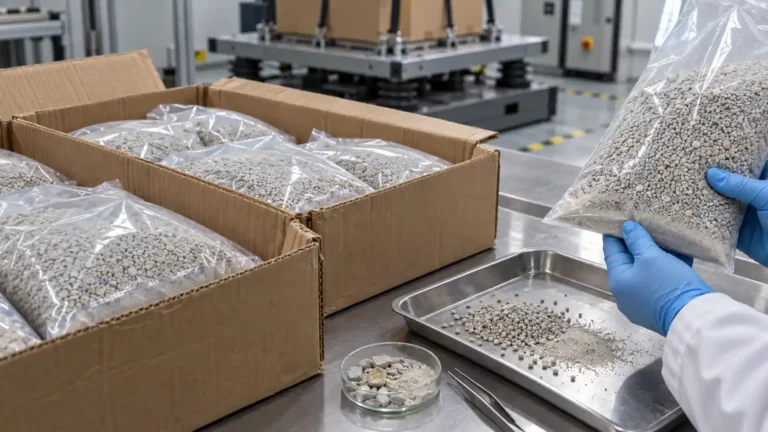
Particle size affects handling, user experience, dust, and sometimes clump behavior. Compare the declared size with the sample and keep a retained portion for future checks. Note broken granules and powder at the bottom of the bag, along with the material visible at the top.
Packaging needs its own specification. Check bag material, seal width, filling tolerance, moisture barrier, carton marks, barcode placement, and pallet arrangement. Ask for the loaded quantity and net-weight tolerance. A bag can meet its product specification and still arrive with leakage or excess fines if the packaging and pallet plan are weak.
When sourcing bentonite, review Bastet’s bentonite cat litter specifications by SKU. Do not treat every bentonite product as one standard material.
What Should Be Checked During Sample Approval?
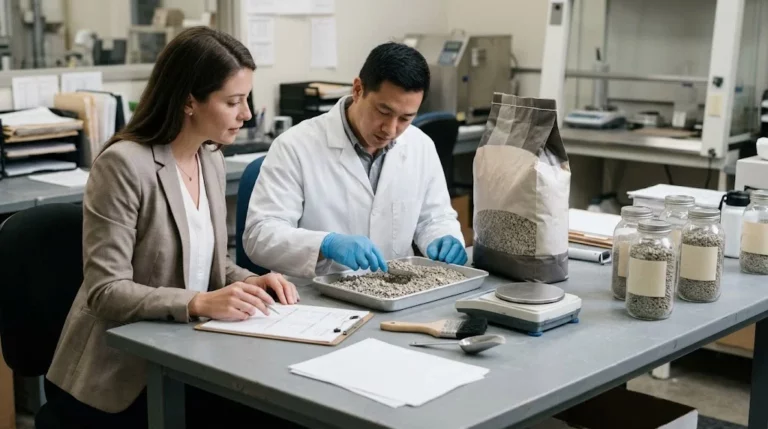
Sample approval should create a clear reference for mass production. Record the sample date, supplier, SKU, batch, photographs, and the person who approved it. Keep enough material for a later comparison.
Use this sample checklist:
Confirm formula and mineral type.
Measure or verify granule size.
Check color, texture, and visible fines.
Run the agreed absorption or clumping check.
Record dust during pouring and scooping.
Confirm fragrance, odor, or additive requirements.
Check pack size, bag artwork, and label language.
Record the approved tolerance for each critical property.
State how production batches will be compared with the sample.
Approval should cover both the product and the packaging. If the supplier changes the formula, granule size, bag, or production site, request a new sample or written change approval.
What Should Importers Confirm Before Shipment?
Before shipment, ask for the final production batch number, quantity produced, final QC report, packing count, net-weight check, and loading photographs. Confirm that the container quantity matches the purchase order and that the labels match the approved artwork.
Commercial details also belong in the shipment file. Confirm the agreed Incoterm, port of loading, shipping schedule, pallet dimensions, container loading plan, insurance responsibility, and customs documents. These items reduce disputes when product, quantity, or packaging differs from the order.
For private-label orders, discuss material, pack format, artwork, and customization in writing. Bastet’s cat litter OEM and private-label options provide a starting point for that discussion. Confirm the final SKU and specification on the quotation and purchase order.
How Can Importers Compare Mineral Cat Litter Suppliers?
Compare evidence as well as price. A supplier scorecard can use the following fields:
|
Area |
Questions to Ask |
|---|---|
|
Product |
Is the formula and granule size clearly defined? |
|
Testing |
Are methods, units, and limits written down? |
|
Документы |
Are COA, SDS, and technical data available? |
|
Production |
Can the factory support the required quantity? |
|
Упаковка |
Can it meet pack, label, and seal requirements? |
|
Quality control |
What happens when a batch fails? |
|
Shipping |
Are loading and inspection records provided? |
|
Настройка |
Are OEM details confirmed in writing? |
Ask the same questions of each supplier. A lower quote is difficult to compare when one supplier includes testing and stronger packaging while another does not.
How Bastet Can Support Mineral Cat Litter Importers
BASTET (Tianjin) Pet Products Co., Ltd. lists mineral, bentonite, tofu, cassava, and crystal cat litter categories. Its company information describes cat litter production and export, product development, raw-material selection, batch quality control and testing, and OEM/ODM customization. Importers can use a written specification to align the approved sample, selected pack format, and future production batches. When comparing crystal products, buyers can also review Bastet’s crystal litter formats by product type and pack requirement.
Часто задаваемые вопросы
Q1: What specifications should importers request for Mineral Cat Litter?
A: Request the mineral type, SKU, granule size, fines limit, moisture, bulk density when relevant, absorption method, clumping data, dust method, packaging details, net-weight tolerance, and batch limits.
Q2: What documents should a cat litter supplier provide?
A: Depending on the destination market, request a COA, SDS, material or ingredient statement, technical data sheet, packaging specification, label artwork, origin information, and retained-sample procedure.
Q3: How do importers verify a sample before bulk production?
A: Record the exact SKU and batch, inspect granules and packaging, run the agreed performance checks, photograph the sample, and keep a retained portion. Confirm in writing how production batches will be compared.
Q4: What should be included in a Mineral Cat Litter COA?
A: The COA should show product and batch identity, production date, test methods, results, units, specification limits, testing party, and pass/fail status. Add product-specific properties such as dust, absorption, or clumping.
Q5: Should importers test Mineral Cat Litter after shipping?
A: Yes, especially after long transport or heavy handling. Compare the delivered batch with the retained reference sample and check broken granules, bottom-bag fines, moisture, seal condition, and net weight.