Cat litter material affects scooping, dust, odor, and disposal. Bentonite, tofu, crystal, and cassava litter each work in a different way. Your cat’s texture choice matters. So do the number of cats in your home and the rules in your market.
This guide compares clumping, odor control, dust, handling, disposal, sustainability, and cost.
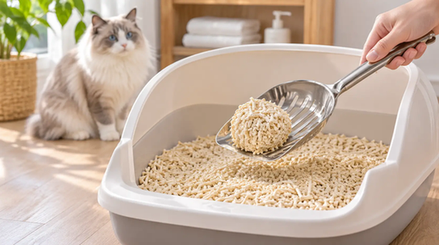
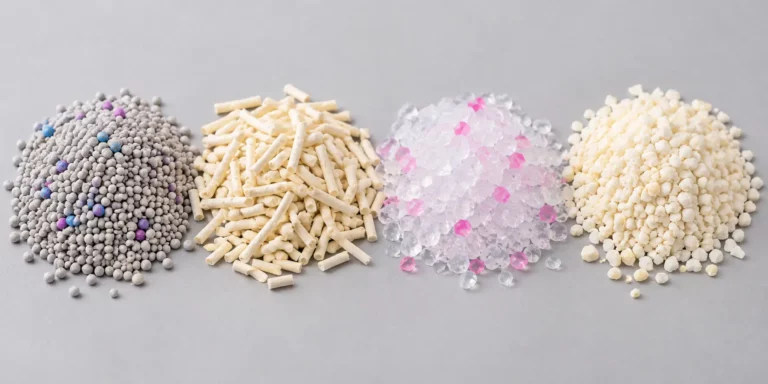
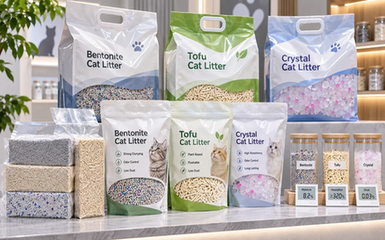
A quick comparison of bentonite, tofu, crystal, and cassava
Use this table as a first guide. Granule size, processing, additives, and quality control can change the result within one material type.
|
Yếu tố |
Bentonit |
Đậu phù |
tinh thể |
Cassava |
|---|---|---|---|---|
|
Vật liệu cơ sở |
Natural clay/mineral |
Plant fiber, often soybean or pea fiber |
Gel silica |
Cassava starch |
|
Moisture handling |
Forms firm clumps |
Forms scoopable clumps |
Absorbs liquid into crystals |
Forms fast plant-based clumps |
|
Odor approach |
Clump sealing and deodorizing additives |
Absorption and odor-control formula |
Moisture capture in porous beads |
Absorption and starch-based odor control |
|
Dust and texture |
Fine, sand-like texture; dust depends on processing |
Lightweight pellets; low-dust formulas are common |
Low-dust crystals in many formulas |
Lightweight granules; dust depends on processing |
|
Xử lý |
Bag and dispose with household waste |
Follow the product label and local plumbing rules |
Bag and dispose with household waste |
Follow the product label and local plumbing rules |
|
Main buying priority |
Firm clumps and value |
Plant-based handling and easy scooping |
Moisture and odor management |
Plant-based absorption and light handling |
These are common material traits. Results vary by SKU. Ask for a sample and product specification before a large order.
Bentonite cat litter: firm clumps and familiar handling
Bentonite is a clay-based mineral litter. Liquid makes the granules bind into a scoopable mass. You can remove the used part and leave clean litter in the box.
Bentonite has a fine, sand-like feel and a wide price range. Check weight, tracking, dust, and clump strength. Screening and granule shape also affect the area around the box.
Bastet’s bentonite category lists 100% natural bentonite clay, 99% dust-free positioning, three-second quick clumping, low tracking, and deodorizing color particles. Its listed specification gives a particle diameter of 0.5-4 mm for a spherical product. The granules are gray and blended with colorful odor-control beads. Confirm these figures for the exact SKU you plan to buy.
The page lists fragrance, color, and packaging customization for OEM programs. Pack formats include stand-up pouches, quad-seal bags, three-side-seal bags, flat vacuum bags, brick vacuum bags, and paper boxes. Ask for test conditions and current batch documents.
Tofu cat litter: plant-based clumping and low-dust options
Tofu litter uses plant fibers formed into pellets or granules. A formula may use soybean residue, pea fiber, corn starch, guar gum, or a blend. The pellets take in liquid and form clumps for daily cleaning.
Tofu is often chosen for plant-based content, soft pellets, or a low-dust routine. Plant materials can take in moisture from the air, so storage matters in humid climates. Follow the finished product’s disposal label and check local plumbing rules before flushing.
Bastet’s tofu product page lists pea fiber and corn starch as main materials. It also mentions soybean, corn starch, and guar gum. The page gives tight clumping, odor control, a 99% dust-free claim, absorption of at least 400%, a dust rate below 5%, and 6 L or 7 L inner packing. Coffee bean, green tea, honey peach, and activated carbon appear as flavor options.
The page uses both "99% dust free" and "dust rate <5%" wording. Ask how each number was measured. Record the result on the approved sample before comparing suppliers.
Crystal cat litter: moisture absorption and odor management
Crystal litter uses silica gel beads. Their pores take in liquid and hold moisture inside the granules. Scoop solid waste and mix the remaining beads as the product instructions direct.
This format suits an absorbent routine focused on moisture and odor. Check the box often because a saturated bed loses odor performance. Bead size and fill depth should match the box and the cat.
Bastet’s crystal product page lists silica gel, sizes from 1-8 mm or a customer-requested size, and blue, gray, and pink color options. It describes the product as dust-free, highly adsorbent, long-lasting, and designed for odor control. Pack examples include 3.8 L, 5 L, 7.2 L, 8 L, and 10 L bags, plus 15 kg and 20 kg compound-bag formats.
For retail or private label, confirm bead size, absorption test conditions, package barrier needs, and replacement guidance.
Cassava cat litter: lightweight plant-based absorption
Cassava litter uses starch from cassava roots. The starch forms granules or pellets that absorb liquid and form clumps. Buyers often choose it for plant-based content and light handling.
Protect plant-based granules from humidity during storage and transport. The finished product may be for flushing, composting, or bagged disposal. The label sets the disposal method.
Bastet’s cassava product page describes natural cassava starch, absorbency, odor control, lower dust, biodegradability, light handling, and a soft texture. It lists coffee, lemon, apple, rose, and lavender flavor options. Pack examples include 5 L/4 kg, 10 L/8 kg, 5 kg, 10 kg, 20 kg, and 24 kg. Logo, fragrance, and package customization are available for OEM orders.
The page shows a 20-day delivery time, a supply capacity of 1,000 tons per month, and references to ISO9001, BSCI, MSDS, and RoHS. Confirm the current lead time, capacity, and certificate scope for the formula and destination before using these details in a contract or claim.
Choosing a cat litter for your situation
Start with the problem you need to solve. Bentonite suits firm clumps and unit cost. Tofu and cassava suit plant-based content and light packs. Crystal suits an absorbent routine focused on moisture and odor.
Dust needs a separate check. A material name cannot predict dust by itself. Granule strength, screening, transport, and the test method all matter. Use a sample in the intended box.
Multi-cat homes and private-label programs need a longer test. Record clump strength, clean litter lost with each scoop, odor over the planned change time, and pack condition during storage.
Disposal needs a local check. Plumbing rules and wastewater systems vary. Follow the approved label.
Checks to make before ordering
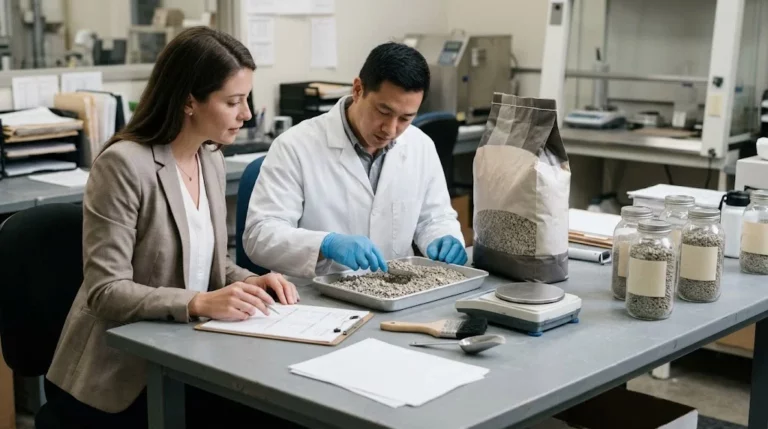
Ask for a sample and test conditions for clump time, clump strength, absorption, dust, and odor. Confirm granule size, pack weight, artwork, MOQ, lead time, shipment terms, and current certificates. Approve the printed artwork and finished pack before mass production.
The cat litter range is a starting point for comparing Bastet’s material categories. Review the individual product specification before requesting a final quotation.
Bastet (Tianjin) Công ty TNHH Sản phẩm thú cưng manufactures and exports pet supplies with a focus on cat litter. Its website presents bentonite, tofu, mineral, cassava, and crystal categories. It also lists OEM/ODM options for packaging, fragrance, color, logo, and product development. The company describes a development team, production equipment, and batch quality-control and testing procedures. The About Us page gives buyers the supplier profile for a specification or sample request.
Câu hỏi thường gặp
Q1: Which cat litter clumps the hardest: bentonite, tofu, crystal or cassava?
A: Bentonite is commonly selected for firm clumps. Tofu and cassava can also form scoopable clumps when their formula and granule structure support fast absorption. Crystal litter manages liquid through absorption inside the beads.
Q2: Is tofu or cassava cat litter better for low-dust needs?
A: Both can support a low-dust product position. Results depend on granule strength, screening, handling, and the test method. Compare supplier data with an approved sample.
Q3: Is crystal cat litter better for odor control?
A: Crystal litter absorbs moisture inside silica-gel pores, which can help manage urine odor. Box size, fill depth, stirring, saturation, ventilation, and cleaning frequency also affect odor.
Q4: Can tofu or cassava cat litter be flushed everywhere?
A: Follow the product label and check local plumbing and wastewater rules. Confirm the formula’s disposal instructions before flushing any litter.
Q5: What should a buyer request from a cat litter supplier?
A: Request a sample, material and granule-size specifications, dust and absorption test definitions, packaging details, MOQ, lead time, current certificates, and disposal guidance. For private label, approve the artwork and pack sample before mass production.